In the European imagination, nineteenth-century explorers were often thought of as intrepid lone adventurers, and they curated their public reputations carefully. In reality, however, their expeditions received funding and support from various public and private institutions. Crucially, they also relied heavily on expertise and labour provided by African intermediaries and workers, whose contributions are often underemphasised in historical accounts.
This virtual exhibition takes a collection of objects in the northern Italian city of Pavia as its starting point. Most of them were collected by Luigi Robecchi Bricchetti, who travelled in northern and eastern Africa between the 1880s and the early 1900s, particularly to places of Italian colonial interest. Using objects from this collection, we invite you to consider what they might reveal, but also what questions they raise about how European exploration was conducted, and about how (or whether) this history is remembered today.
RB 211, flask
Presumably made in Europe, this flask depicts a European man with a gun, flanked by two women in formal dresses. What does it tell us about the image European explorers had of themselves? How did they seek to represent ‘European-ness’ – or Italian-ness, in this case – on their travels? How did that contrast with the image of Africa conveyed by his collections and descriptions?
“the expedition has made the name of Italy known, and also, I hope, loved and respected, by many peoples who had previously ignored its existence” (Robecchi Bricchetti, 1899, Somalia e Benadir, p. 649).
“Let us remember that trade has always been the most certain vehicle of civilisation, that among the Somalis there are highly profitable elements to be cultivated, advantages to be seized, influences to be developed. Therefore, we need boldness, patience, and endurance”. (Robecchi Bricchetti, 1903, Nel paese degli aromi, p. 536f)
RB 569, compass
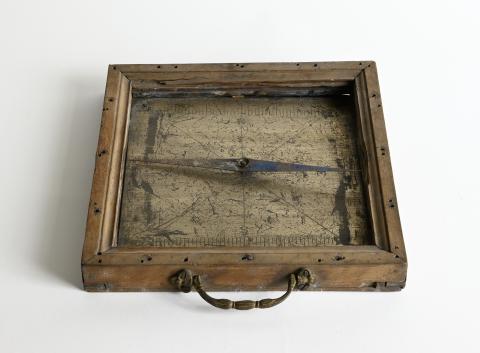
Like many explorers of his generation, Robecchi Bricchetti was constantly asking institutions to fund his expeditions. When he requested support from the Italian Geographical Society in Rome, he was disappointed that they sent him equipment – including a compass – instead of money. In a description of his 1888 expedition to Harar, Ethiopia, Robecchi Bricchetti writes:
“I had actually asked for a small grant from our Geographical Societies, but at the time, my name was too unknown… Only the Italian Geographical Society in Rome supported me… with a small aneroid, two thermometers, a pocket compass, two letters of recommendation, and infinite sincere good wishes”. (Robecchi Bricchetti, 1896, Nell’Harrar, p. 2)
It is not clear whether this compass is the one the Italian Geographical Society sent him, but it nonetheless gives us an idea of the kinds of material support he was able to secure, and perhaps even a glimpse into the Italian Geographical Society’s aims. How and why did institutions support exploration in Africa, and what were their priorities? How did Europeans acquire geographical knowledge of Africa, and how was it subsequently used?
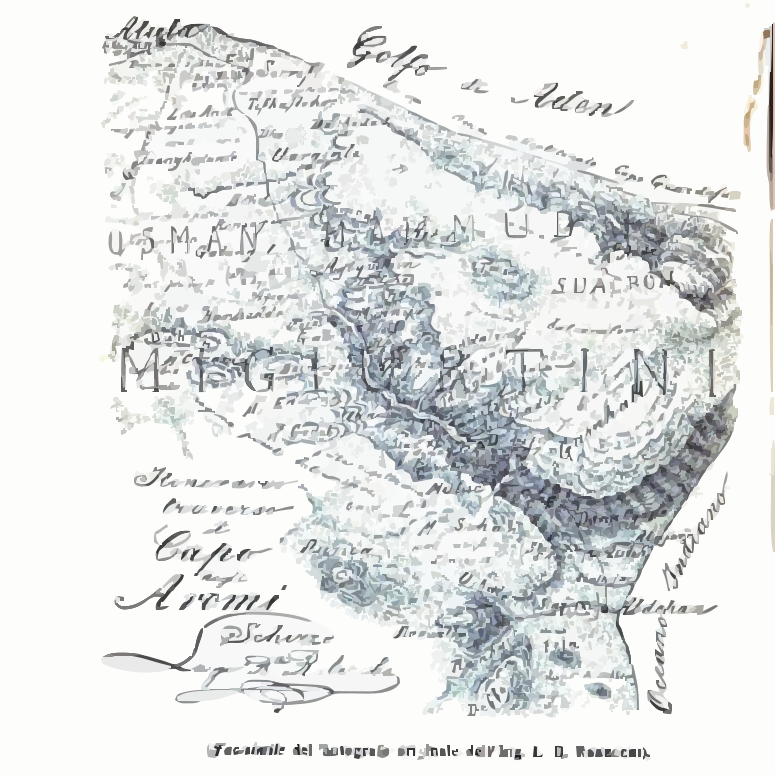
“I marked in my diary… the angles of my compass, and the duration of each path… which made it possible for me to construct the first complete map of the entire route…. On the very day of my arrival in my homeland, I was able to deliver this map to His Excellency the Minister of Foreign Affairs, who … was pleased to order a 1:500,000 reproduction of it, carried out in Florence by our Military Geographic Institute”. (Robecchi Bricchetti, 1903, Nel paese degli aromi, p. 445)
This Italian military map based on Robecchi Bricchetti’s data, depicting the route of his travels in Somalia in 1890, is stored in the municipal library of Chambéry in France: https://bibliotheque-numerique.chambery.fr/idviewer/25251/1
Firearms
These three guns, from the collection of Robecchi Bricchetti’s firearms held in Pavia, invites us to consider: on what violence, both threatened and exerted, did European exploration in Africa rely?
RB 296, rifle
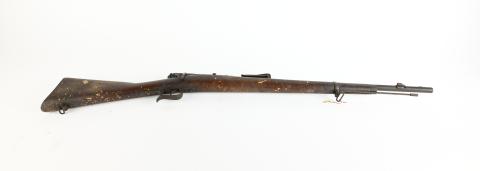
This is a woodworm-damaged Vetterli: an advanced rifle used by many European armies at the time, including the Italian military. The twenty-first-century inventory of Robecchi Bricchetti’s collection describes this as a gun intended “for indigenous troops”, but it is not clear where that information originally came from.
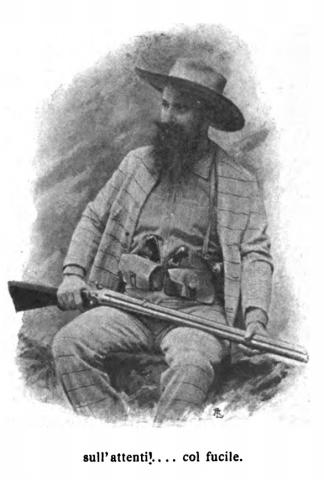
When Robecchi Bricchetti boasts about ‘travelling light’ for his 1888 expedition to Harar – encouraging us to think of him as a resourceful man of action – most of his luggage consists of firearms. He writes that he did not even pack a tent, but weapons were clearly indispensable.
“The arrangements for departure were made quickly; they were very simple. One chest for personal belongings, one for books, two hunting rifles, a Vetterli repeating rifle, a pair of revolvers, and a few hundred cartridges”. (Robecchi Bricchetti, 1896, Nell’Harrar, p. 2)
RB 279, revolver
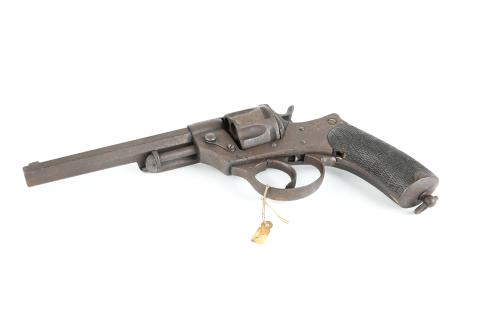
A 1990s inventory describes this as a “firearm used by the explorer mainly in case of clashes with Somali populations…”. In his travel narratives, Robecchi Bricchetti describes acts of violence carried out by himself and the soldiers that accompanied him, presenting them as heroic acts of self defence against hostile ‘natives’.
“My Somalis conducted themselves heroically. … Of mine, few were injured, and not seriously. Six or seven of our adversaries were dead, and how many injured I do not know. My soldier Hassan gifted me a bow and some arrows taken from an enemy he had killed: I have kept them to this day as a souvenir of the event” (1899, 131).
How do the large teams of African soldiers, guards, and guides employed to accompany Robecchi Bricchetti complicate the carefully-cultivated image of the ‘intrepid European explorer’? How does the supposedly neutral language of the inventory – the description of ‘clashes’, for instance – obscure the violence that enabled these expeditions?
RB 310, hunting rifle
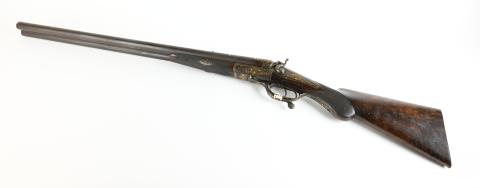
The 1990s inventory describes RB310 as a “rifle for big-game hunting”. Like many European travellers in Africa at the time, Robecchi Bricchetti was preoccupied with hunting, and used the firearms he brought with him for this purpose.
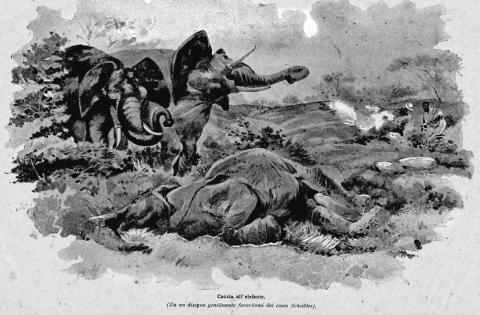
Robecchi Bricchetti’s collection in Pavia includes hunting trophies and animal skins. This raises the question: why were European travellers, exemplified by this substantial collection of animal remains, so preoccupied with animal hunting in Africa? What was the purpose of bringing back so many trophies and animal skins?
Arrows
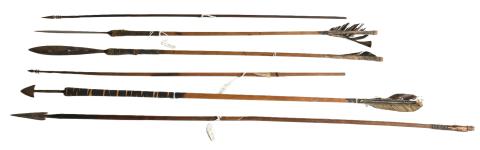
From top to bottom: RB 351; RB 347; RB 343; RB 333; RB 344; RB 348
As we have seen, European travellers used weapons in acts of violence against local people. But they also collected examples of local weapons for other reasons, and many ethnographic museums hold substantial collections of shields, spears, bows, and arrows. Anthropologists studied which technologies were used in particular locations, but not only out of mere curiosity. Dominant theories in Europe at the time proposed that cultures existed on a hierarchy, from the supposedly ‘simple’ to the ‘sophisticated’. Many European travellers therefore collected weapons as part of an attempt to place their users on a scale of ‘development’.
“The technology of war seemed to provide the perfect data for studying the gradual ‘evolution’ of human culture, from the simplest forms to more complex forms. It seemingly linked – and yet distinguished – all human beings throughout the world”. (Gosden, Larson and Petch, 2007, Knowing Things: Exploring the Collections at the Pitt Rivers Museum 1884-1945, p. 47)
Comments
Leave your comment for the research group here.
- What other histories does this section bring to mind?
- How can we challenge or complicate the dominant image of the intrepid explorer?
- What aspects of European exploration in Africa would you like a future exhibition to cover?