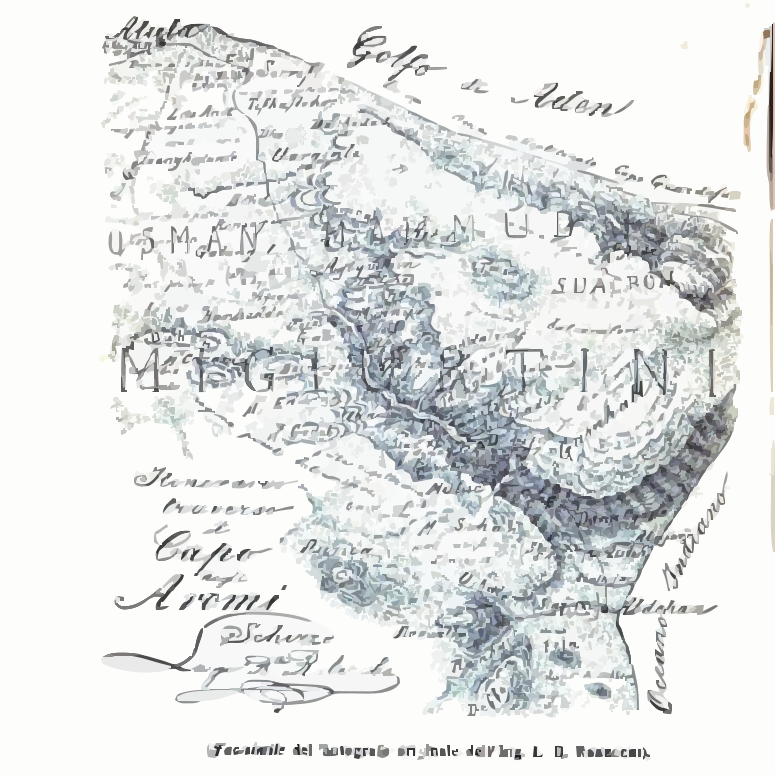
Collecting, transporting, and displaying an object changes its meaning. So does the way it is described, and the decision to display (or not to display) an item. Here, we trace the journeys of Robecchi Bricchetti’s collections, with a focus on their ‘afterlives’: the various meanings they have been given since they were collected over a century ago.
Selling
Robecchi Bricchetti sold various types of objects to institutions – especially to universities and museums – with the help of Italian government ministries. What fuelled the demand for ‘ethnographic’ objects from museum curators, and indeed, from the Italian state? Why might the Italian state have been interested in buying objects from current and prospective colonial territories in Africa, and what image of these territories were they trying to convey with these collections?
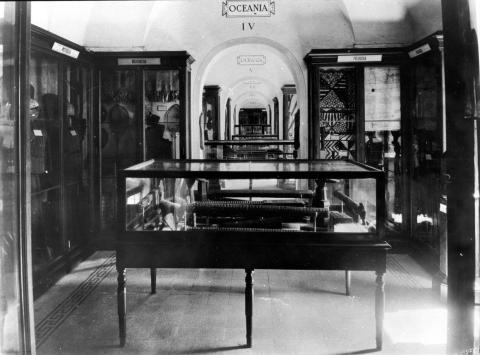
(Museo delle Civiltà, RomeCC BY-SA 4.0, via Wikimedia Commons)
In 1890, Rome’s Prehistorical and Ethnographic Museum bought a selection of ‘ethnographic’ objects collected by Robecchi Bricchetti. This photograph shows another section of that museum, but gives a sense of how such collections were originally displayed.
Donating
Italy’s Fascist government designated 21 April 1926 as the country’s first ‘Colonial Day’, to be marked across the country. In Pavia, one of the main events was the opening of the Colonial Museum, largely made up of objects donated to the city by Robecchi Bricchetti.
The 1926 Colonial Day took place on the anniversary of the legendary foundation of Rome: a deliberate attempt to associate contemporary Italian colonialism with the Roman Empire. However, it was part of a concerted effort to stimulate support for colonialism across Italy, including in smaller cities like Pavia.
On Italy’s first Colonial Day, the front page of the local newspaper, Il Popolo, carried an article on “Colonial Consciousness” by Paolo Vinassa, a professor at the University of Pavia who had travelled extensively in Italian colonial territories. Alongside it was a piece describing Robecchi Bricchetti as “one of the Italian pioneers in Somalia”, and advertising the opening ceremony for the new Colonial Museum.
Displaying
Most of Pavia’s Colonial Museum was made up of objects collected by Robecchi Bricchetti. However, it also included around thirty items collected in Eritrea by Giovanni Boretti, an Italian major who led the siege of Saati in 1887, the first battle of the Italo-Ethiopian war, and around twenty items collected in Somalia by Enrico Petrella, a young pilot from Pavia, who died in a plane crash in Mogadishu in 1921.
RB 146, small woven container
This colourful woven container, collected by Enrico Petrella, was displayed alongside Robecchi Bricchetti’s collection.
Why might it have been important for the curators to display African objects from three generations of Pavia-born colonialists alongside one another? What might this have done for ‘colonial consciousness’ locally, and who was the target audience for this spectacle? What might have been the effect of these displays on those who viewed them, and what image of Africa, and the Italian presence there, did they convey?
< Previous Page: Collecting | Next Page: Present and Future >
Comments
Leave your comment for the research group here.
- How is colonial history remembered (or forgotten)?
- What role can material culture play in telling stories about the past?
- How can we reimagine archives, museums, and visible traces of difficult histories?